

By Connor Jorgensen, Director of Business Development, TUSK Practice Sales
Picture the day you hand over the keys. The day you walk out of your operatory for the last time as the owner. Now count backward. If that day is five years out, the decisions that shape your exit are the ones you are making right now.
For dentists considering selling a dental practice in Virginia, Maryland or Washington, D.C., five years may sound like plenty of time. In reality, the financial and operational decisions you make today can directly influence the value of your practice when you eventually go to market.
When a dentist tells me they are about five years out, they usually mean they will start thinking about a transition in four years and sell in five. That math does not work that way. By the time you decide to go to market, the two or three years of financials sitting behind you are already shaping the offers you will receive. You still have five years of runway, and that matters because a buyer needs continuity of care and does not have a replacement ready to step in for you.
Your Own Timeline Matters as Much as the Practice’s
Let’s talk about your goals first. When do you actually want to step back from the chair?
If you are asking, “When should I sell my dental practice in Virginia?” or considering when to sell a dental practice in Maryland or Washington, D.C., your personal retirement timeline needs to be considered alongside the financial performance of the practice.
If your plan is to start dialing down your own production and working toward more work-life balance, that has to be timed carefully. You need to be prepared to keep practicing while you are in market, and potentially for a few years after. DSO deals commonly come with a three-to-five-year employment agreement after close. More than ever, buyers roll the numbers forward through the diligence process once you have signed a letter of intent (LOI) to confirm your trends are holding.
Too many times, dentists have taken their foot off the pedal while actively speaking to buyers, only to face a lower valuation because the buyer loses confidence in a practice with weakening performance. It is important to note that for traditional doctor-to-doctor transactions, there is typically a more limited transition period and diligence can be less extensive for smaller transactions.
What Planning the Sale of Your Dental Practice Involves
A clean transition with a DSO is a body of work that takes time. This is true whether you plan to sell a dental practice in Virginia, sell a dental practice in Maryland, or are considering selling a dental practice in Washington, D.C.
Buyers will be valuing your life’s work based on a trailing twelve months of practice performance. They will be looking at your revenue, earnings before interest, taxes, depreciation and amortization (EBITDA), service mix, payer mix, patient counts, geography, team and much more.
These factors can be especially important in competitive Mid-Atlantic markets. The market for Virginia dental practice sales, Maryland dental practice sales and Washington, D.C. practice transitions can vary significantly by location, practice size, specialty, profitability and buyer demand.
When you work with an advisor, they piece together all the marketing materials before you go to market. This also helps identify areas where you may face scrutiny during the diligence phase. An experienced advisor or one of the established Virginia dental practice brokers or Maryland dental practice brokers can help owners understand how buyers may evaluate their practices before the sale process formally begins.
That work includes clean financials with documented add-backs for a defensible and normalized EBITDA, production by provider reports, hygiene numbers, and the other measures mentioned above that tell a consistent story over time. This process typically takes anywhere from four to six weeks to prepare.
Then comes taking your practice to market, which gives you the opportunity to meet each of the buyers and make sure there is cultural and financial alignment. Once you have selected a buyer, you enter the diligence phase, where a quality of earnings team will verify your advisor’s numbers.
Most DSO transactions run six to nine months from pre-market preparation to close, and these are months that do not count toward your post-close employment agreement.
Why Preparation Matters in Virginia, Maryland and Washington, D.C.
Owners sometimes assume that preparing to sell begins when they decide to list the practice. In reality, successful Virginia dental transitions and Maryland dental transitions often begin years before a practice reaches the market.
Early preparation gives you an opportunity to improve profitability, address staffing concerns, strengthen patient retention, review your lease or real estate situation, document financial add-backs and reduce potential questions that could arise during due diligence.
It can also help position the practice more effectively when buyers begin searching for a dental practice for sale in Virginia, dental practice for sale in Maryland or dental practice for sale in Washington, D.C.
Depending on the opportunity, prospective buyers may be searching specifically for a dental office for sale in Virginia or dental clinic for sale in Virginia. Others may be evaluating dental offices for sale in Maryland, dental clinics for sale in Maryland, or opportunities throughout the Washington, D.C. metropolitan area.
Preparing your practice before it reaches this buyer pool can give you more control over how the opportunity is presented and how potential buyers perceive its value.
Where You Actually Stand
So, work backward from the date you want to be out.
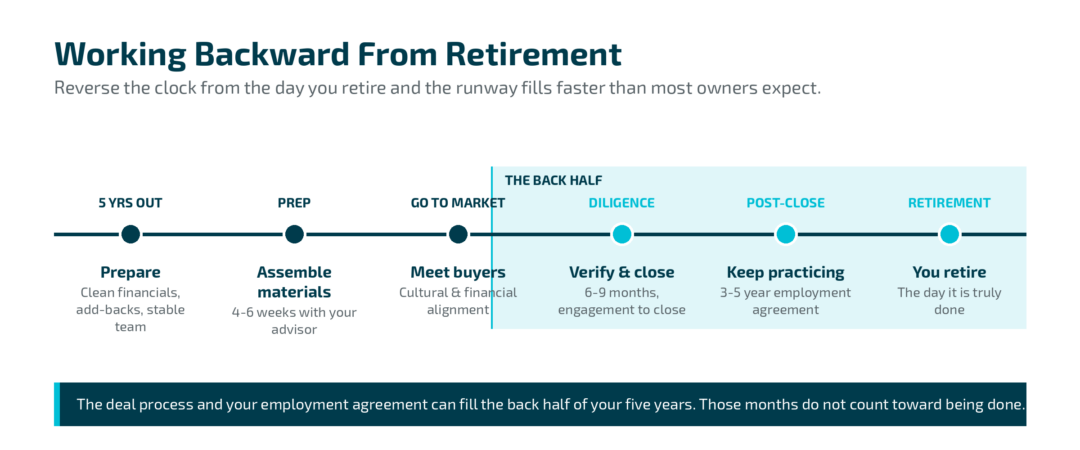
If you want to be fully done in five years, you likely need to go to market now. The deal process, plus a typical transition period, can consume the back half of that window before you have done anything else.
If you want out in six or more years, now is the time to prepare. Understand what your practice is worth, stabilize your team and fix structural issues while you still have the runway to do it calmly.
This preparation can be valuable whether you eventually work with a Virginia dental practice brokerage, Maryland dental practice brokerage, a dental broker in Maryland, or a professional specializing in dental practice brokerage in Washington, D.C. The objective is the same: understand where you stand before circumstances dictate when and how you sell.
The doctors who leave money on the table are almost always the reactive ones. A health event, burnout, a competitive landscape where nearby practices pull away patients, or a difficult operating environment where margins compress can all force a dentist to sell. They were not prepared, and instead of selling at a peak, they are settling.
What Buyers Looking for Dental Practices for Sale Will Evaluate
Understanding the buyer’s perspective can also help you prepare. Dentists evaluating dental practices for sale in Virginia, dental practices for sale in Maryland or dental practices for sale in Washington, D.C. are not simply looking at top-line collections.
They want to understand whether the practice can continue performing after ownership changes. That means examining provider production, hygiene performance, patient retention, staffing, overhead, payer mix, facility needs, technology, lease terms and other factors that can influence future cash flow.
The same principle applies whether a buyer is considering a dental clinic for sale in Maryland, one of several dental offices for sale in Virginia, or a dental office for sale in Washington, D.C. A well-prepared practice gives buyers a clearer story and can reduce uncertainty during the transaction.
Get Honest With Yourself
If you take nothing else from this, sit with a few questions.
- When do I actually want to retire from dentistry?
- What do I truly need out of a sale, both financially and operationally?
- Can I maintain or even grow this practice on my own from here, or do I need to bring on a team to keep the trends moving in the right direction?
If you are wondering how to sell my dental practice in Maryland, Virginia or Washington, D.C., these questions should come before choosing a buyer or negotiating a purchase price. Your desired retirement date, financial goals and willingness to remain with the practice after closing can all influence the type of transaction that makes the most sense.
You do not have to be ready to sell your dental practice to start getting ready. A dental practice valuation and an honest conversation about your timeline is the cheapest, lowest-pressure step you can take, and it tells you exactly where you stand today. You are in control. You make the choices.
Planning to Sell Your Dental Practice in Virginia, Maryland or Washington, D.C.?
Whether you are planning a transition within the next year or your ideal exit is still five or more years away, early preparation can give you more options and greater control over the process.
DDSmatch Mid-Atlantic helps dentists navigate Virginia dental practice sales, Maryland dental practice sales and practice transitions throughout Washington, D.C. If you are considering selling a dental practice, want to better understand your practice’s value, or simply want to know what you should be doing now to prepare for a future sale, a conversation with an experienced transition professional can help you establish your next steps.
Schedule a Call with Todd Garfinkel at DDSmatch to discuss your timeline, practice and transition goals.